
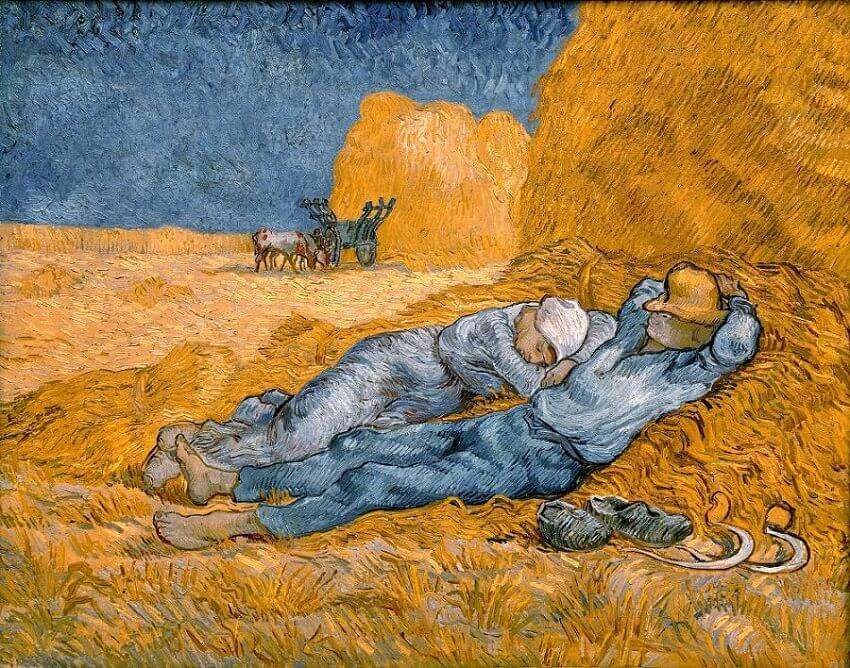
Noon-Rest from Work (after Millet) – Vincent Van Gogh, 1890
Come to Me, all you who labor and are heavy laden, and I will give you rest. Take My yoke upon you and learn from Me, for I am gentle and lowly in heart, and you will find rest for your souls. For My yoke is easy and My burden is light.
– Matthew 11.28–30
To all of our Chrysostom Academy families, students, and faculty, happy summer! Our third year flew by, and I can’t believe it is already over. It feels like just yesterday we gathered to open the school with our Festival of Flags. We’ve had so many good and fun times, your break is well deserved. As we disperse for the season, I pray everyone is able to spend some time with family, and recover from this fast-paced year. Last week when we finished up the with our Gryphon Games and Festival of Bees, I began reflecting on the nature of work and rest in today’s world. Watching our faculty and staff interact with our students these last two weeks has been on the one hand stressful and on the other hand, amusing. Our students were very excited for the summer, and it manifested as they turned their minds towards the break and away from school. At one point after chapel, we were treated to a spontaneous choir concert where the main piece was the Phineas and Ferb theme song. One of my staff remarked to me that our teachers were in the bargaining phase of the year. By the end, everyone finished the year happy but exhausted. Luckily, academia is the last institution in the modern world to keep a humane schedule that acknowledges burnout and intentionally integrates a season of rest into its yearly schedule. As the world has modernized, more and more institutions have turned away from seasons of work and rest, in favor of one singular season of work with rest or time away from work being frowned upon. However, anyone who has worked in academia know that students need a break, but so do their teachers and administrators. This doesn’t just apply to academia, but the entire world. Anyone who has worked knows everyone needs a break.
Today, the statistics around burnout are mind-boggling. According to Forbes, more than 66% of the American workforce is facing burnout in 2025. While this average is bad enough, 81% of 18-24 year old, and 83% of 25-34 year old young adults are experiencing burnout, vs. just 49% of adults 55 and older. This is hardly surprising. Looking at the vacation data, private-sector employees receive an average of 11 days paid leave after one year, and only 18 days per year after 18 years of employment. As people grow up and not only enter the workforce but also raise families and juggle both work and life, this is not enough time away. On top of that, many employers ask their employees to be available for email or phone conversations at all times, meaning employees, even when on vacation, cannot truly get away. This constant pressure of always being available to work contributes to huge stress and mental health problems, creating a spiral many people feel they cannot escape from. In popular terms, this anxiety about work and not getting away has been called the Sunday Scaries. In looking at the current problem, lets rewind the clock and take a look at how we as humans used to work.
For most of human history, work was seasonal, with large periods of time, especially in the winter or rainy season, being a period of social interaction and household chores, rather than the backbreaking work of farming. There is even a popular meme online showing how medieval peasants worked only 150 days out of the year on planting and harvesting their crops. In the winter, families gathered together to sing, butcher the fatted animals, and prepare for the spring. While still “working” life slowed down. During the height of the Roman Empire, there were around 135 days of festivals, imperial birthdays, and other days where work ceased. Today, if we include all Federal holidays and weekends plus 11 days of paid leave, the American worker has 126 days off, less than the average Roman or Medieval peasant. However, many do not get all the Federal Holidays off, meaning that number is less than 120 for many people working today. Not only are there less days off, there is no season of slowing down, with work being focused on efficiency and productivity at all times. Knowing this history, how should we approach rest and burnout?
The Book of Genesis begins with the creation account of the world. During the first 6 days, God fashioned all of creation, but on the 7th day, He rested and observed all He had created, for it was good (Gen 2.2–3). This day was sanctified as a day of rest. Some in the Early Church even considered Christ’s resting in the tomb on the 7th day to be a mirror of this rest. Yet, we know Christ was hard at work harrowing Hades and raising all to the Father (Eph 4.8–10). The ancient Sabbath, while a day of rest, was set aside for God. The ancient Israelites were commanded to keep the 7th day holy. This day, then, was dedicated wholly to God. In addition to this day of rest, there were 7 important feasts of God, where time slowed down and was dedicated to God. This pattern of feast and Sabbath was in addition to the seasons of work and rest found naturally in agricultural societies. This pattern was also received in the Church, with the emphasis moving to the 8thday, the day of resurrection, and the 12 Major Feasts of the Church. However, these days too were set aside for God alone. This, then, is how we should approach burnout and understand the need for rest.
Christ tells us to come to Him and we will receive rest. Today’s world is burnt out not only physically, but spiritually, and emotionally as well. When we do have time off, we don’t dedicate that time to God, but often to just recovering from the week. This is important, but looking after our spiritual needs is just as important. A recent convert to Christianity, former Muslim and New Atheist thinker Ayaan Hirsi Ali, talks about how she had unmet spiritual needs which she could not meet even with therapy and intentional living. Her soul was disquieted, as much as her body and mind. This, then, is the key to understanding the need for a break from work. Not only do we need a break from work, we need a seasonal approach to that time, as well as time dedicated not just to ourselves, but to God.
Chrysostom Academy lives out all of these tenets in our academic calendar. We adhere to the feasting and fasting seasons of the Church, nourishing our spirits. We ensure there is ample time in the summer for work to cease or slow so people can tend to their families and households, nourishing their emotional well-being. Finally, we build in days of rest beyond what may be strictly necessary, meaning our bodies are looked after as well. However, we keep at the front of our entire ethos Christ’s invitation to find rest in Him. If more institutions took this wholistic approach, the world would look like an entirely different place. We know this firsthand at Chrysostom Academy. When we leave for the summer, our faculty, staff, and students are anxious to get away. However, as we approach the school year, they are all anxious to return. How many people, upon taking vacation, are not only willing but yearning to return to their place of work? So this summer, we invite you to join us in our physical rest, our emotional rest, and our spiritual rest in God.
As always, in the final words of St. John Chrysostom, “Glory to God for All Things!”
In Christ,
John W. Heitzenrater, II A.B., M.H.M.
Headmaster
jheitzenrater@chrysostomacademy.org
610-427-2758
St. John Chrysostom Academy
www.chrysostomacademy.org