
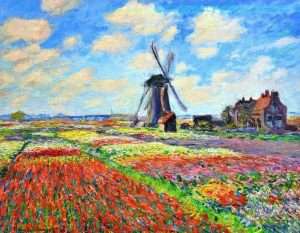
Tulip Fields – Claude Monet 1886
I did not come to call the righteous, but sinners, to repentance.
– Luke 5.32
Towards a True Repentance
If asked by a non-Christian to define the word repentance, what is the proper answer? Is it justice? Mercy? Sorrow for sins? No. Today, I posit that the answer is none of these. Instead, repentance is the humbling of ourselves by acknowledging our own weaknesses and sins because we love God.
“To love the Lord thy God with thy heart, and with thy soul, and with thy mind and to love our neighbors as we love ourselves” (Mat. 22.37) is the summation of all of Christ’s teachings. At the heart of these teachings (loving God and loving our neighbor) is the implied commandment, repent. It was this word that St. John the Forerunner spoke in the wilderness in preparation for the coming of the Messiah. It was this act that moved the Good Thief to exclaim, “Remember me, O Lord, when Thou comest into Thy kingdom!” (Luke 23.42). It was for this purpose that the prodigal son returned home to the embrace of his father after squandering his inheritance. It was this sorrow that moved Peter to weep for his sins after denying our blessed Lord.
Everyone is called every day to crucify their will and to repent of their sins for love of God and neighbor. We do so that we may be found worthy of being faithful. But this act of faithfulness is not something to obtain and never worry about again. We desire to be righteous but are not righteous. In the Scriptures, those who claim for themselves the title of righteous are also called a brood of vipers and hypocrites. True righteousness is something that most people cannot obtain fully in this world. Everyone is called by the Holy Spirit, but only a few are chosen (Matt 22.14). We know these chosen as the saints, many of whom performed miracles and acts of profound holiness in their earthly lives. These righteous men and women light the way for us who live in darkness of this world. They are the beacons which guide us to calm and safe harbors. However, unlike these shining few, most of us are drowning in the dark seas.
We may know some who have repented. We may know great sinners who have rejected a life of sin and turned toward a life in Christ. Perhaps we know a very pious priest, priest-wife, or a lay person who seeks to live a righteous life. I know personally many who are trying to live a life of righteousness, and hopefully, we ourselves are living as righteously as we can. But we are not yet righteous. We must repent every day if we wish to be perfect. Despite the challenges of becoming holy, we are given a capacity for great holiness, not through our own goodness, but through God’s grace.
“Most assuredly, I say to you, he who hears My word and believes in Him who sent Me has everlasting life, and shall not come into judgment, but has passed from death into life.” (John 5.24). Here, Christ gives us a roadmap towards eternal life. Faith begins with repentance, and repentance begins with an act of love. We repent because we love Christ and believe that He can heal our brokenness. Through this act of love, He can make us whole. This relationship between loving Christ and repentance is not by accident, for if our faith is to be fruitful, we must be moved by true love for Christ. Our blessed Lord asks St. Peter, “Peter, lovest thou me”? (John 21.15). Peter responds as we all do, “of course I love thee, oh Lord. Our Lord asks him 3 times, all with Peter’s affirmative. Interestingly, the love our Lord is asking him (ἀγάπη) is different than the one Peter responds (φιλία). One is selfless and unconditional, the other more human. This exchange illustrates the essence of our earthly life. God wants our unconditional love, and this starts with unconditional repentance.
But how do we do this? The Church, in her eternal wisdom offers us a prescription. As a hospital for sinners, Christ the Divine Physician directs us to pray. If we love God we will pray; and if we pray our love for God will grow. Prayer is the seed of repentance that we sow every day in the garden of our souls. Prayers done with love for God and love for neighbor will produce fruits that feed us and give us life. But here is the key, our prayer must be selfless, unconditional, and cultivated every day in order to grow. Prayer requires patience, simplicity, and perseverance. “Those who are well have no need of a physician, but those who are sick.” (Mark 2.17). When we are sick, we rest, drink plenty of fluids, and avoid being around others lest we also infect them.
The same is true when we are spiritually broken except for one caveat. We must go to Christ through the Church to be healed. We cannot sit out and avoid going to the hospital. Christ calls us to repentance, prayer, and sacrifice, by which He can heal the wound and set us on the path toward wholeness. When we are on the path to recovery, we must be vigilant in following the prescription He gives so the weeds that sprout up can be removed as soon as they rear their ugliness. Furthermore, we continue to take steps every day to nurture the health of the soul by guarding the seeds planted and keeping out the wild animals that come into our garden to steal, or worse to destroy the work being done.
We may fall victim to the idea that this is too much, and is ultimately, unbearable. Yet, we are reassured by the Lord for He says, “My burden is easy and My yoke light” (Mat 11.28–30). Let us imagine for one moment a gardener who is very diligent in planting his garden. He follows all of the rules, plants the seeds in the right way, dusts the dirt off of his hands, wipes the sweat from his brow, and sits down to enjoy a glass of iced tea. He rightly feels very good that the garden is planted, but then reasons to himself, “that was easy!” Over the subsequent months, he neglects certain important tasks. He allows the weeds to grow without removing them. He notices that there is some damage to his plants, but doesn’t take care to protect them. At the time of harvest, he has produced some good fruits, but his other plants failed. He barely has enough for himself, and what he does have is below average.
Now, consider the gardener who struggles initially to plant seeds in his garden. He tills the earth, waters appropriately, and then spends time every day working his land. Planting is difficult, but he vows not to take any chances with the harvest he is hoping to reap. Every day he removes the weeds from the garden. He works on placing chicken wire around the perimeter to keep out predators, he waters the garden, makes notes about what is growing and what is not, and as the season progresses, his fruits multiply. Before he knows it, he has so much fruit that he’s obliged to share them with everyone around him. Every day was a struggle, but the struggle was worth the harvest. And when he goes to plant next season, he will remember the challenges he faced and plan accordingly. The process was simple, the exercise, if done every day, was light.
The first gardener is like many of us who repent and pray with fervor and then celebrate our victory. We do not notice the weeds or the damage that creep in, and when we do, it is too late. We become stagnate, sedentary, and before long the weeds and the predators have caused so much destruction that there is far more work to do than would have otherwise been necessary. The second gardener toiled every day to produce good fruits. His humility and prudence temper his excitement. His first and last thought is, “every day, Lord, I will repent. Every day I will give glory to Thee.” Today, he reasons, was a victory, but tomorrow is not certain. If I let up, I will have to work that much harder the next day. It is better, he believes, to work the land every day in order to get the results he wants. He is watchful, patient, and most importantly consistent.
We must pray as if every day is the first day we have prayed. We must repent every day as if it is our last day on earth, that we will meet our Lord and have to give an account of our lives. If we repent every day, we renew that love we have towards the Lord. Like the gardener, we are able to root out all of the weeds sowed by the enemy that choke the growing fruits of our soul. To do this, we have many tools at our disposal: We have the Mysteries and Liturgy, the Fathers and Scripture. We also have powerful prayers to keep up with the weeding, the most effectively of which, is the simple Jesus Prayer; Lord Jesus Christ, Son of God, have mercy on me a sinner.
“I can of Myself do nothing, says our Lord in St. John’s Gospel, because I do not seek my own will but the will of the Father who sent Me.” On our Lenten journey, let us embrace repentance every day. Seek to love our blessed Lord with our whole mind, heart, and will, and to love our neighbors as we love ourselves. Cultivate with prayer the garden of our souls. Be vigilant, watchful, and persistent, removing the weeds of sin from our spiritual soil and keeping at bay the enemy of our souls who, with enough rejection will find another garden to attack, returning only to sow unclean weeds and mischief to keep us constantly on watch. He calls each one of us to repentance so at the end, we may as a good and faithful servant bring the fruits of our toils to feast with Him in His heavenly banquet. Repent today, tomorrow, and the next.
Glory to God for All Things!
In Christ,
John W. Heitzenrater, II A.B., M.H.M.
Headmaster
jheitzenrater@chrysostomacademy.org
610-427-2758
St. John Chrysostom Academy
www.chrysostomacademy.org